
Concrete Services in Alexandria, Virginia
Strong Concrete Work Built for Lasting Use
Concrete fails from below far more often than from above. Acacia General Contractors pours and finishes concrete for properties in Alexandria, VA, and across Northern Virginia, Washington, and Maryland, giving as much attention to grading, compaction, reinforcement, and joint layout as to the finished surface, because those hidden decisions determine whether a slab holds up through 20 hard Virginia winters.
Our crews handle residential and commercial flatwork alike: driveways, patios, porches, sidewalks, walkways, recreational vehicle pads, block walls, and retaining walls built to hold a slope where it belongs. Mix design gets matched to the application and the season, air entrainment protects against freeze and thaw cycling, and control joints get cut on a plan rather than wherever seemed convenient. Backed by 25 years of masonry and concrete work, we are licensed, insured, and bonded. Send dimensions and photos through our contact page for an estimate.
Concrete Work We Handle
Concrete Driveways
Thickness gets matched to the actual load, from 4 inches for passenger cars to 6 inches with a rebar grid where trailers park. Base preparation and joint spacing then determine whether the cracking stays controlled and largely invisible over the years.
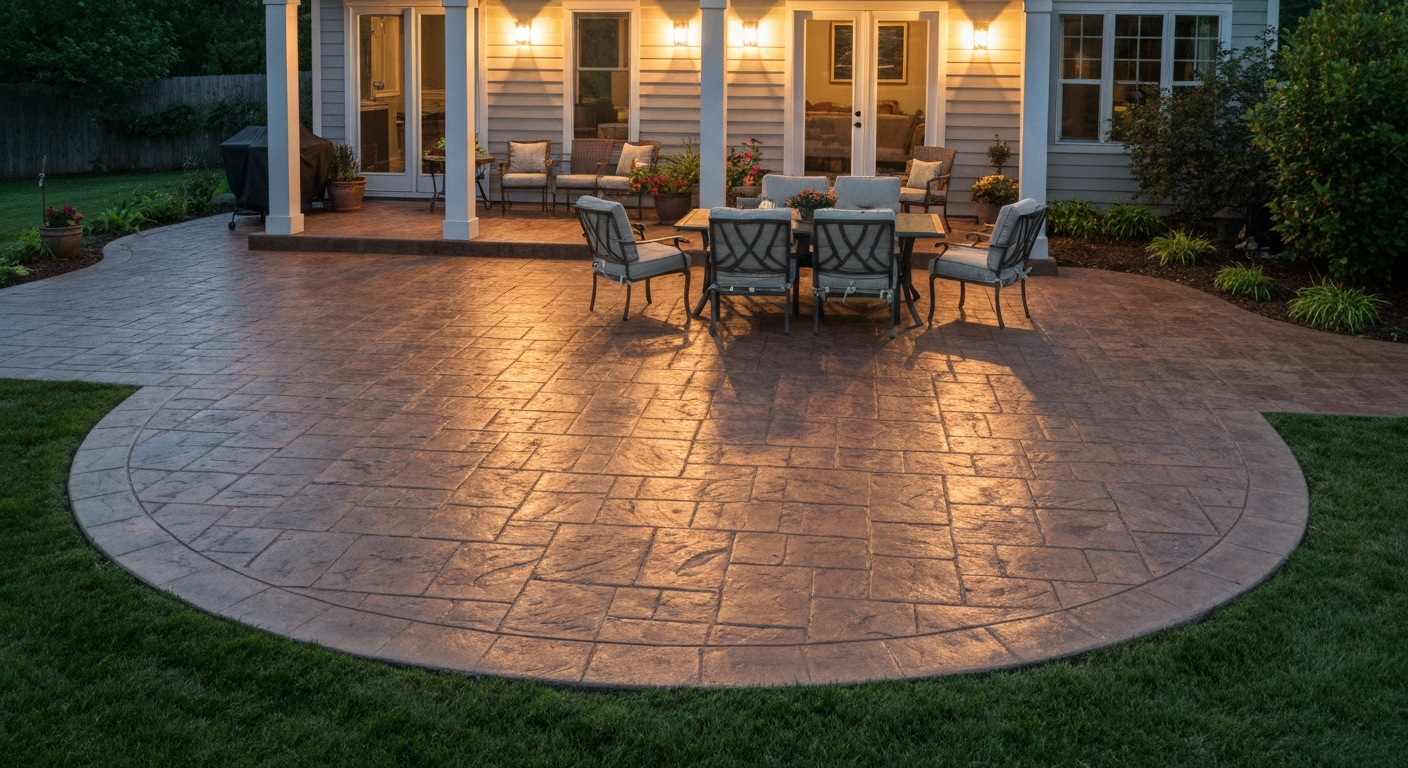
Patios and Porches
Outdoor living surfaces need positive drainage away from the foundation and a finish that stays grippy when it is wet. Broom, exposed aggregate, and stamped options each change both the texture underfoot and how the space reads visually.
Sidewalks and Walkways
Consistent width, proper slope, and joint spacing that follows the slab thickness keep a walkway both safe and level. Tree roots and settled subgrade cause most of the failures we see, so preparation addresses both before any pour.
Recreational Vehicle Pads
Heavy loads concentrated on small footprints demand thicker sections and reinforcement placed on chairs at the correct depth. A properly compacted base and adequate slab dimensions prevent the edge cracking that plagues undersized and underbuilt pads within a few seasons.
Block Walls
Structural block requires level footings set below frost depth, correct grout and rebar placement, and clean consistent coursing. Whether the wall encloses a yard or supports a structure, the layout always begins with a footing that has been built right.
Retaining Walls
Holding back soil is an engineering problem long before it is an appearance one. Drainage behind the wall, proper base depth, and batter or reinforcement sized to the actual load are what keep it from leaning forward a decade from now.
How Quality Concrete Adds Strength and Stability
Decades of Service From a Single Pour
Properly placed concrete outlasts asphalt and gravel by a wide margin, with no resurfacing cycle and no annual regrading to schedule. The surface you get is essentially the surface you keep for the remaining life of the property.
Maintenance That Barely Registers
An annual wash and a fresh sealer every couple of years is the entire routine. Compared with patching asphalt or replenishing gravel that keeps migrating into the lawn, the ongoing effort involved is close to nothing at all.
Cracking That Stays Where You Planned It
Concrete shrinks as it cures and will crack somewhere eventually. Correct joint spacing and depth decide that location in advance, so the surface keeps straight controlled lines instead of the random spidering that ruins the appearance of an otherwise good slab.
Curb Appeal That Reads as Finished
A clean driveway, a level walkway, and a defined patio give a property visual order that landscaping alone can never supply. It is one of the first things visitors and prospective buyers register on approach to the house.
Surfaces That Handle Weight Without Complaint
Trucks, trailers, dumpsters, and equipment all sit on properly designed slabs without rutting or depression. Matching thickness and reinforcement to actual use means the surface never becomes one more thing you have to protect and worry about all year long.
Drainage That Protects Your Foundation
Slope, elevation, and placement all work to direct water away from the building rather than toward it. Getting the grade right on flatwork quietly prevents exactly the kind of basement moisture problems that cost far more to solve later on.
Start With a Surface Built to Last
A driveway or patio is not the part of a property anyone photographs, but it is the part everyone walks across daily and the first thing to look neglected when it was rushed. Acacia General Contractors takes the unglamorous steps seriously, the compaction, the reinforcement depth, the joint plan, because those are what a slab is still standing on in 20 years. Nobody thanks a contractor for good compaction, and that is exactly the point. If you have a surface to replace or new flatwork to plan anywhere around Alexandria, VA, send dimensions and a few photos through our contact page and we will put a straightforward estimate together.
FAQs - Frequently Asked Questions
What is the difference between concrete and cement?
Cement is the active ingredient within concrete. It reacts chemically with water and binds sand, gravel, and aggregate together into the finished material. Concrete is the product you walk on, and cement is just one of the components inside it.
How long before I can drive on new concrete?
Concrete reaches roughly 90 percent of its design strength within seven days, so passenger vehicles are fine after about a week. Keep heavy trucks, loaded trailers, and dumpsters off the surface for a full 30 days after the pour.
What temperature is right for pouring concrete?
Dry conditions above freezing, with 60 to 80 degrees Fahrenheit being ideal for placement. Cold ground stalls the reaction that builds strength, so winter pours need insulated blankets, heated enclosures, or a mix design that has been properly adjusted.
How thick should a residential driveway slab be?
Four inches handles passenger vehicles well on a properly compacted base. Acacia General Contractors steps up to 5 or 6 inches with a reinforcing grid on Alexandria, VA, driveways where recreational vehicles, trailers, or delivery trucks park regularly.
Why does new concrete crack even when installed correctly?
Shrinkage during curing is entirely unavoidable, so control joints are cut to guide where that separation occurs. Cracks that follow those joints are working exactly as designed rather than signaling any kind of failure in the slab or its installation.
Does concrete need sealing?
Sealing every two years protects against moisture penetration and de-icing chemicals, which matters considerably through Virginia freeze and thaw cycles. Pressure washing once a year removes the residue and organic staining that shorten a surface's usable appearance.
Can you pour over an existing concrete slab?
Sometimes, when the base underneath is stable and the elevation allows for it. Bonded overlays work on sound surfaces, but slabs with structural cracking, heaving, or drainage problems need removal so that the underlying cause gets addressed properly first.
How soon can we walk on a new patio?
Foot traffic is generally fine after 24 to 48 hours depending on the temperature and mix. Acacia General Contractors leaves specific timing instructions on every Alexandria, VA, project, since cure rates change noticeably with the season and the mix.